
How Much Protein Does a Dog Actually Need?


Protein is one of the most important nutrients in a dog’s diet.
It supports:
- muscle
- skin and coat
- enzymes
- hormones
- immune function
- tissue repair
- normal growth
- countless everyday metabolic processes
Yet protein is also one of the most misunderstood parts of dog nutrition.
Some owners are told to avoid “too much.”
Others assume the highest protein percentage must automatically mean the best food.
Neither approach is particularly useful.
The better question is:
How much protein does this individual dog need, and is that protein coming from a well-formulated, complete diet?
So How Much Protein Does a Dog Actually Need?
There is no single percentage that suits every dog.
Protein needs vary with:
- age
- growth
- activity
- body condition
- reproductive status
- health
- digestibility of the food
- quality of the protein
- total calorie intake
A growing puppy, an active working dog, a healthy senior dog and a sedentary adult dog are not nutritionally identical.
That is why protein should never be judged in isolation.
Minimum Requirement vs Optimal Intake
This is an important distinction.
Nutrition standards set minimum requirements designed to prevent deficiency.
But a minimum requirement is not necessarily the same thing as the amount that is ideal for every dog.
For example, a diet may technically meet the minimum protein requirement while still providing less protein than another formula designed to support a higher-protein feeding philosophy.
That is why we think owners should look beyond the question:
“Does it meet the minimum?”
and also ask:
“Does this nutritional profile make sense for my dog?”
Why Protein Matters So Much for Muscle
Muscle is built from amino acids.
Dogs constantly break down and rebuild body proteins.
Dietary protein supplies the amino acids needed to support that process.
This matters throughout life.
Not just in puppies.
Adult dogs need protein to maintain lean tissue.
Active dogs need it to support recovery and muscle maintenance.
Older dogs need it because maintaining muscle becomes increasingly important with age.
This is one reason we do not believe healthy senior dogs should automatically be pushed toward low-protein feeding simply because they are older.
Protein Is Not Just About Muscle
People often think of protein only in terms of muscle.
But amino acids are used throughout the body.
Protein contributes to:
- skin structure
- hair growth
- enzymes
- antibodies
- transport proteins
- hormones
- tissue repair
A dog’s body is using dietary protein every day, whether that dog is sprinting around a paddock or sleeping on the couch.
Does More Protein Always Mean Better?
No.
A crude protein percentage is useful, but it does not tell you everything.
Two foods can both say 30% protein and still be very different.
You also need to think about:
- where the protein comes from
- how digestible it is
- the amino-acid balance
- the overall calorie level
- fat content
- fibre
- complete vitamin and mineral balance
So we would never say:
“The highest protein number wins.”
But we also do not believe protein should be treated as something to fear in a healthy dog.
Protein Quality Matters
Dogs need amino acids, not simply a number on the guaranteed analysis.
Different protein ingredients contribute different amino-acid profiles and digestibility.
That is why the source and quality of the protein matter.
Animal-derived proteins are particularly useful because they can provide highly valuable amino acids for dogs.
But the whole formulation still needs to be complete and balanced.
A recipe should not rely on one attractive meat ingredient on the front of the bag while ignoring everything else.
What Does Crude Protein Actually Mean?
The crude protein percentage on a pet food label estimates the total protein in the food based largely on its nitrogen content.
It does not directly tell you:
- how much comes from animal ingredients
- how much comes from plant ingredients
- how digestible the protein is
- the exact amino-acid quality
- how much of that protein the dog ultimately utilises
So crude protein is useful.
But it is a starting point, not the whole story.
Why Dry Food Percentages Can Be Misleading
One complication is moisture.
Dry food contains relatively little water.
Wet food contains much more.
That means you cannot always fairly compare a dry food’s protein percentage directly with a wet food’s percentage without accounting for moisture.
For example, a canned food may show a much lower protein percentage on the label simply because the product contains far more water.
For accurate comparisons across very different food formats, nutritionists often use a dry matter basis.
For most owners comparing one dry kibble with another dry kibble, the label percentages are much easier to compare directly.
Do Dogs Need Animal Protein?
Dogs require specific amino acids.
Those amino acids can come from different ingredients.
However, animal proteins commonly provide useful amino-acid profiles and are highly relevant in canine nutrition.
This is why our own formulation philosophy places a strong emphasis on animal-derived protein.
We do not believe a dog food should merely hit a crude protein number on paper.
We want the protein contribution to make nutritional sense.
Why We Favour Higher-Protein Formulations
At Pet Food Australia, our nutritional philosophy has always placed substantial emphasis on protein.
That comes partly from formulation knowledge and partly from decades of hands-on experience with dogs.
We have worked with dogs across many ages, sizes and conditions, and we have repeatedly seen the importance of maintaining:
- muscle
- healthy body condition
- good coat quality
- appropriate energy
- overall resilience
Protein plays a central role in all of that.
That does not mean every dog needs exactly the same protein percentage.
It means we believe protein should be treated as a core nutritional priority, not something to reduce automatically.
High Protein Does Not Mean High Calories
This is another common misunderstanding.
Protein percentage and calorie density are not the same thing.
A food can be:
- high in protein and moderate in fat
- high in protein and high in fat
- moderate in protein and high in calories
Fat is far more calorie-dense than either protein or carbohydrate.
So if an owner is trying to manage weight, the answer is not necessarily to choose a low-protein food.
The better approach is to consider:
- total calories
- fat level
- feeding amount
- activity
- body condition
while still maintaining adequate protein to support lean tissue.
This Matters Especially for Overweight Dogs
When dogs lose weight, the goal should not simply be:
“Make the number on the scales smaller.”
We want to reduce excess body fat while preserving as much lean muscle as possible.
That is one reason protein remains important during sensible weight management.
A lower-calorie approach does not have to mean a nutritionally weak diet.
This same principle is behind why we believe lower-fat feeding and adequate protein can work together.
Puppies Need Protein for Growth
Puppies are building tissue rapidly.
They need adequate protein and amino acids to support:
- muscle development
- organ growth
- skin and coat
- enzymes
- hormones
- normal development
But puppies also need the correct overall mineral and calorie balance, especially large-breed puppies.
So feeding puppies is not about chasing the highest protein percentage.
It is about feeding an appropriately formulated growth diet.
We will cover that separately in our Feeding Large Breed Puppies guide.
Active Dogs May Need More
A very active dog may have higher overall nutritional demands than a sedentary household pet.
Working dogs, sporting dogs and highly active dogs need enough calories and nutrients to support their workload.
Protein can become particularly important for maintaining and repairing lean tissue.
But again, total food intake matters.
If an active dog eats more calories from a complete food, they will naturally consume more grams of protein as well.
This is why percentages alone never tell the whole story.
Senior Dogs Still Need Protein
This deserves repeating.
Healthy older dogs do not automatically need low-protein food.
As we discussed in What Changes as Your Dog Gets Older?, ageing dogs can lose muscle.
Protecting lean body tissue becomes increasingly important.
Reducing protein unnecessarily may work against that goal.
Certain medical conditions may require a different dietary approach, but age itself is not a diagnosis.
Does High Protein Damage Healthy Kidneys?
This is one of the most persistent concerns around protein.
In a healthy dog with normal kidney function, protein should not automatically be restricted because of fear that it will cause kidney disease.
Dogs with diagnosed kidney disease may require a different nutritional strategy, and that should be managed with veterinary guidance.
That is very different from saying:
“High protein causes kidney disease in healthy dogs.”
Those are not the same claim.
Why Owners Often Notice Better Energy on a Different Food
One of the things Pet Food Australia customers frequently tell us is that their dog seems to have more energy after changing foods.
That can happen for many reasons.
It may reflect changes in:
- protein intake
- fat intake
- energy density
- digestibility
- body condition
- feeding amount
- overall dietary suitability
We cannot look at one customer report and say protein alone caused the change.
But when a dog is receiving a nutritional profile that suits them better, owners often see the difference in:
- enthusiasm
- play
- walks
- recovery
- overall behaviour
That real-world feedback matters.
We Also Hear About Skin, Coat and Body Condition
Protein supports skin, hair and lean tissue.
And over the years, many customers have told us that after switching to Pet Food Australia they noticed:
- healthier-looking coats
- improved body condition
- better energy
- less scratching
- better overall appearance
Again, those observations do not prove protein was the only reason.
The whole formulation changed.
But they reinforce our belief that strong nutrition should be judged by what happens to the whole dog, not one laboratory number.
Protein Should Work With the Rest of the Diet
This is the key message.
A strong protein level is important.
But it should sit alongside:
- appropriate fat
- useful fibre
- essential fatty acids
- vitamins
- minerals
- appropriate energy
- good digestibility
That is why our philosophy is not:
“More protein at any cost.”
It is:
“Provide substantial, useful protein as part of a complete and balanced formulation.”
What Should Owners Actually Look For?
When comparing dry dog foods, ask:
- What is the crude protein percentage?
- What are the main protein sources?
- Is the food complete and balanced?
- What is the fat level?
- Does the calorie density suit my dog?
- Is the dog maintaining muscle?
- Is body condition appropriate?
- Is energy good?
- Are stools consistent?
- Does the coat look healthy?
- Is the dog thriving on the food?
Those questions are much more useful than simply asking whether a food is “high protein” or “low protein.”
The Bottom Line
Dogs need protein throughout life.
Puppies need it for growth.
Adults need it for maintenance.
Active dogs need it to support workload.
Older dogs need it to help maintain lean tissue.
The exact amount depends on the individual dog and the complete diet.
But protein should not be treated as an optional extra.
It is a fundamental nutrient.
And in our view, a well-formulated dog food should provide enough quality protein to support the body the dog needs to maintain every day.

Once owners understand that protein is essential, the next question is usually:
“What percentage should I actually be looking for?”
That is where things become more nuanced.
There is no universal protein percentage that is perfect for every dog.
A dog’s needs depend on:
- age
- activity
- body condition
- calorie intake
- reproductive status
- health
- digestibility
- protein quality
So rather than looking for one magic number, it is more useful to understand what the number on the bag actually means.
Minimum Requirements Are Not the Same as Ideal Intake
Nutritional standards establish minimum amounts needed to support normal health.
That is important.
But a minimum is exactly that:
a minimum.
It tells you the lower threshold that should be met.
It does not necessarily tell you what is ideal for:
- an active dog
- a growing dog
- a senior dog
- a dog trying to maintain muscle
- a dog eating fewer calories during weight management
This is one reason we believe owners should not stop at:
“Does it meet the standard?”
A better question is:
“Does this protein level make sense for the dog eating it?”
Why Percentages Can Be Misleading
A crude protein percentage sounds straightforward.
But percentage alone does not tell you how much protein the dog is actually eating each day.
Imagine two foods:
One contains 25% protein.
Another contains 30%.
If the second food is much more calorie-dense and the dog eats a smaller portion, the actual daily protein intake may be closer than the percentages suggest.
That is why nutritionists sometimes look at protein in relation to calorie intake rather than percentage alone.
The dog does not eat percentages.
The dog eats grams of food and calories.
Protein Per Calorie Matters
This becomes especially important in dogs eating restricted portions.
For example, an overweight dog may need fewer total calories.
If the owner simply cuts the amount of a relatively low-protein food, the dog receives less:
- energy
- protein
- vitamins
- minerals
all at the same time.
That may not be ideal.
A diet with a stronger protein contribution can help provide useful amino acids while calorie intake is being controlled.
This is why weight management should focus on losing fat while protecting lean tissue, not simply shrinking portions as much as possible.
High Protein and Low Fat Can Work Together
Protein and fat are separate nutritional variables.
A dog does not have to eat a high-fat diet in order to receive substantial protein.
This is an important principle behind our own approach.
A dog that needs lower calorie density may benefit from:
- strong protein
- controlled fat
- appropriate fibre
- measured portions
rather than simply reducing everything.
That is particularly relevant for older, less active or weight-prone dogs.
What About Very Active Dogs?
Highly active dogs often have much greater energy requirements.
That can include:
- working dogs
- sporting dogs
- dogs exercising for long periods
- very active young adults
These dogs may eat considerably more food than sedentary household pets.
When they consume more of a complete diet, they naturally receive more total protein too.
Their nutritional requirements therefore have to be considered alongside:
- energy demand
- fat intake
- recovery
- body condition
- workload
Simply choosing the highest protein percentage without enough energy can still leave an active dog underfed.
Growing Puppies Need More Than Just Protein
Puppies require substantial protein to support growth.
But protein is only one part of puppy nutrition.
They also need carefully balanced:
- calcium
- phosphorus
- fat
- vitamins
- minerals
- energy
This is especially important in large-breed puppies, where excessive growth rates and inappropriate mineral balance can create problems.
So a puppy food should be judged as a complete growth formulation, not simply by its protein percentage.
Why Senior Dogs Deserve Particular Attention
Older dogs are one of the groups where protein discussions become especially important.
As dogs age, they may begin losing muscle.
That loss can happen gradually and may be missed if body weight remains relatively stable.
A senior dog may weigh the same but have:
- less muscle
- more body fat
- reduced strength
- reduced mobility
That is why we believe maintaining adequate protein becomes increasingly important with age.
The goal is not to make an older dog bulky.
It is to help preserve the lean tissue they already have.
Age Alone Is Not a Reason to Cut Protein
This is one of the strongest points we want owners to understand.
A healthy older dog does not automatically need a low-protein diet simply because they are senior.
Protein restriction may be appropriate in certain diagnosed medical conditions.
But that is very different from assuming all old dogs should eat less protein.
We prefer to separate:
age
from
disease
A healthy senior dog still needs amino acids.
What About Kidney Disease?
Once a dog has diagnosed kidney disease, dietary management becomes more complex.
The goal may involve adjusting:
- phosphorus
- protein
- sodium
- energy
- hydration
depending on the stage and individual case.
That should be managed with veterinary guidance.
But it is important not to confuse a therapeutic diet for kidney disease with a general feeding rule for healthy dogs.
Healthy kidneys and diseased kidneys are not the same situation.
Why Protein Has Been Feared for So Long
Protein has often been discussed as though it places unnecessary stress on the body.
That has led some owners to believe that feeding substantial protein is inherently risky.
But the more useful question is:
Is the dog healthy, and is the diet appropriately formulated?
Protein is not simply waste.
It provides essential amino acids the body actively uses.
The goal should not be to minimise protein unnecessarily.
It should be to provide enough for the dog’s needs while keeping the whole formulation balanced.
Quality Still Matters
A high percentage can look impressive.
But if the protein contribution is poorly balanced or relies heavily on ingredients that do not provide the same amino-acid profile, the number alone can be misleading.
This is why we keep returning to:
- source
- digestibility
- amino-acid balance
- whole-diet formulation
At Pet Food Australia, we place strong emphasis on meaningful protein from animal-derived ingredients as part of a complete recipe.
Protein and Skin
Protein contributes directly to skin and coat structure.
Hair itself contains protein.
Skin is constantly being renewed.
That means amino acids are required for normal:
- coat growth
- skin maintenance
- tissue repair
This does not mean high protein cures itchy skin.
But inadequate or poorly suited nutrition can certainly affect how the skin and coat look and feel.
That is one reason we pay attention when customers report that after switching foods they notice:
- shinier coats
- reduced scratching
- better skin condition
The whole formulation may be contributing.
Protein is part of that picture.
Protein and Energy Are Not the Same Thing
This is another area of confusion.
Owners sometimes see a dog with more energy and assume the food must simply contain more calories.
Not necessarily.
A dog may appear more energetic because:
- they are maintaining muscle better
- digestion suits them better
- body condition improves
- overall nutrient intake is better matched
- they are more comfortable
So when Pet Food Australia customers tell us:
“My dog has more energy now,”
we do not assume one nutrient alone caused it.
We look at the complete change in diet.
Customer Feedback Matters Here Too
Over the years, we have heard from many customers who tell us their dogs seem:
- stronger
- more energetic
- more playful
- leaner
- better muscled
- more comfortable
after changing foods.
We cannot say protein alone created those outcomes.
But the consistency of the feedback reinforces something we believe strongly:
dogs often do very well when their diet provides substantial quality protein as part of an appropriate overall formulation.
That matters especially when the alternative is a diet where protein has been treated as something to minimise.
How Should Owners Compare Two Dry Foods?
If you are comparing similar dry foods, start with:
Crude protein
Then look at:
Crude fat
Then look at:
Energy density
Then ask:
What are the primary ingredients?
Where does the protein appear to come from?
Is the food complete and balanced?
Does the nutritional profile suit the dog’s age, activity and body condition?
That gives you a much more useful picture.
What Percentage Do We Like?
We do not believe there is one perfect number.
But our own formulations reflect a clear philosophy:
we favour substantial protein levels rather than formulating diets around the lowest amount required.
For healthy adult dogs, we believe protein should be treated as a central nutrient.
That is why several of our recipes sit around the higher-protein end of conventional dry dog food.
The exact formula still depends on the purpose of the recipe.
A lower-fat food can still maintain strong protein.
A puppy food needs growth-appropriate balance.
A specialised formula may have different priorities.
Does High Protein Make Dogs Hyperactive?
Not inherently.
Behaviour and activity are influenced by many factors:
- genetics
- age
- training
- environment
- exercise
- health
- total calorie intake
Protein itself should not be treated as a simple switch that makes dogs “hyper.”
A dog receiving better overall nutrition may appear more energetic or engaged, but that is not the same thing as pathological hyperactivity.
Can Protein Make a Dog Gain Weight?
Any food can contribute to weight gain if total calorie intake exceeds what the dog uses.
Protein itself is not uniquely fattening.
Fat provides more than twice as many calories per gram as protein or carbohydrate.
So when managing weight, we look at:
- total calories
- fat level
- feeding amount
- activity
while still maintaining adequate protein.
How Much Protein Is Too Much?
For a healthy dog eating a complete and balanced commercial diet, the more practical concern is usually not that the protein percentage is “too high” in isolation.
The bigger questions are:
- Is the food balanced?
- Is calorie intake appropriate?
- Is the dog healthy?
- Is the dog maintaining ideal body condition?
- Is the dog tolerating the diet well?
More is not always better.
But substantial protein within a properly formulated food is not something we believe healthy dogs need to fear.
Let the Dog Help Answer the Question
Ultimately, nutrition is not just numbers.
Look at the dog.
Are they:
- maintaining muscle?
- maintaining healthy body condition?
- energetic?
- recovering well after activity?
- producing good stools?
- maintaining healthy skin and coat?
- enjoying their food?
Those outcomes help tell you whether the overall nutritional profile is working.
The Practical Rule
If you want one simple principle from this section, it is this:
Do not choose protein based on fear, and do not choose it based on the highest number alone.
Choose a complete food with:
- meaningful protein
- appropriate fat
- appropriate calories
- good ingredient quality
- balanced vitamins and minerals
Then feed an amount suited to the dog

The final piece of the protein discussion is where theory meets the real world.
A food can look impressive on paper.
It can have a high crude protein percentage.
It can list several protein ingredients.
It can carry all the right marketing language.
But ultimately, the question is:
How does the dog actually do on it?
That is where our experience with Pet Food Australia matters.
Over the years, we have heard from thousands of customers who have told us their dogs changed noticeably after switching foods.
They often describe:
- better energy
- improved body condition
- better muscle tone
- healthier-looking coats
- reduced scratching
- improved stools
- greater enthusiasm at mealtimes
- older dogs seeming more active again
Those reports do not prove that protein alone was responsible.
They are not controlled clinical trials.
But they are real-world outcomes that repeatedly reinforce the same broader principle:
when dogs are given a complete diet with substantial quality protein, appropriate fat, suitable energy and a formulation that agrees with them, many appear to thrive.
Animal Protein vs Plant Protein
Not all protein contributes in exactly the same way.
Dogs need amino acids.
Those amino acids can come from animal and plant ingredients.
But animal-derived proteins generally provide amino-acid profiles that are especially valuable for dogs.
That is why we place strong emphasis on animal protein in our formulations.
Plant ingredients can still contribute useful protein, fibre, energy and micronutrients.
The issue is not:
animal good, plant bad.
The better question is:
what is each ingredient contributing, and is the complete amino-acid profile strong enough?
Why the Source Behind the Number Matters
A 30% protein food does not tell you where that 30% came from.
Some of it may come from:
- meat
- fish
- poultry
- legumes
- peas
- other plant ingredients
That is not automatically a problem.
But it does mean the crude protein percentage needs context.
At Pet Food Australia, we do not want the protein number to look good only because of mathematical tricks.
We want the formulation itself to make nutritional sense.
What Is Ingredient Splitting?
Ingredient splitting is something owners may hear about when reading pet food labels.
It refers to listing similar ingredients separately.
For example, instead of one large ingredient appearing high on the list, components may appear individually lower down.
This can sometimes make the ingredient list look more meat-heavy than it really is.
That is why reading a pet food label requires more than looking at the first ingredient.
Owners should consider:
- the overall protein percentage
- the named protein sources
- the fat level
- the fibre level
- the complete recipe
- the dog's real-world results
The ingredient list is useful, but it should not be the only thing you judge.
Why We Do Not Chase the Highest Number
We believe in substantial protein.
But we do not believe in chasing a headline figure simply so the bag looks more impressive.
A food with 35% protein is not automatically better than one with 30%.
If the 30% food has:
- strong animal protein contribution
- suitable fat
- appropriate energy
- useful fibre
- good digestibility
- balanced vitamins and minerals
it may be the better formulation for a particular dog.
The whole profile matters.
Protein Has to Work With Energy
This is especially important.
Protein does not exist in isolation.
A dog also needs enough energy.
If the dog is underfed overall, they may still struggle to maintain body condition even if the protein percentage looks good.
Likewise, if a food is extremely energy-dense and the owner overfeeds it, the dog may gain too much weight.
That is why protein, fat and calories need to be considered together.
Why This Matters for Older Dogs
This is one of the areas where our customer feedback has been especially striking.
We regularly hear from owners of older dogs who say things like:
“He is playing again.”
“She has so much more energy.”
“He honestly seems younger.”
We do not claim food reverses ageing.
It does not.
But we have heard this feedback too many times to dismiss it.
A dog moving onto a diet that better supports:
- muscle
- body condition
- digestibility
- energy needs
- overall nutritional intake
may genuinely feel better.
And when an older dog feels better, owners often describe that as “acting younger.”
That is real-life proof of one thing:
nutrition can make a meaningful difference to how a dog functions day to day.
Why This Matters for Skin and Coat
We also hear very consistent feedback around skin and coat.
Many customers tell us that after changing to Pet Food Australia:
- the coat becomes shinier
- dry-looking skin improves
- scratching reduces
- paw chewing reduces
- the dog appears more comfortable
Again, protein is only one part of this.
Skin and coat health also depends on:
- essential fatty acids
- vitamins
- minerals
- overall calorie intake
- the dog's individual health
But protein supplies the amino acids used to build and renew skin and hair.
So strong protein intake absolutely belongs in that broader picture.
Why This Matters for Body Condition
Another thing owners often notice is that their dog looks “better.”
That can mean:
- leaner
- better muscled
- stronger
- less soft around the middle
- more athletic
That matters because body weight alone does not tell the whole story.
A dog can weigh the same but carry more muscle and less fat.
That is usually a much better outcome than simply trying to make the number on the scales smaller.
This is another reason we believe protein deserves attention.
Why This Matters for Weight Management
Owners sometimes assume weight management means feeding less protein.
We do not agree with that as a general rule.
The goal in sensible weight management is:
lose excess fat while protecting lean tissue.
That often means:
- control calories
- control fat
- feed an appropriate portion
- maintain useful protein
This is exactly why a lower-fat formula can still be built around strong protein.
The two ideas are not contradictory.
Why This Matters for Active Dogs
Active dogs need nutrition that supports what they actually do.
A highly active dog may need:
- more calories
- more total protein
- appropriate fat
- good recovery support
If the food is too low in energy, the dog may need to eat excessive volumes.
If the protein is too modest, the total amino-acid intake may not match the workload.
Again, balance matters.
Real-World Results Are Part of the Evidence
We believe pet nutrition should be judged in two ways.
First:
Does the formulation make nutritional sense?
Second:
What happens to the dog eating it?
This is where Pet Food Australia has accumulated a large amount of real-world feedback.
Owners have repeatedly reported improvements in:
- energy
- coat
- scratching
- stool quality
- appetite
- body condition
- activity
- general comfort
Those reports are not random marketing slogans.
They are the lived experience of customers feeding the food every day.
We are careful not to turn that into a medical claim.
But we are equally careful not to ignore it.
When thousands of owners independently describe similar improvements, it becomes meaningful evidence that the formulation is working well for many dogs.
The Dog Is the Final Test
You can read every label.
You can compare every protein percentage.
You can analyse every ingredient.
But eventually, the dog gives you the answer.
Ask:
- Is muscle being maintained?
- Is body condition appropriate?
- Is the dog energetic?
- Are stools consistent?
- Is the coat healthy?
- Is scratching improving?
- Is appetite good?
- Is the dog thriving?
If the answer is yes across several of those areas, the overall diet is probably doing something right.
How Pet Food Australia Approaches Protein
Our approach is simple.
We favour:
- substantial protein levels
- meaningful animal protein sources
- different protein options
- appropriate fat
- useful fibre
- complete vitamin and mineral nutrition
- ingredients chosen for a reason
- recipes built around the needs of the whole dog
We do not believe every dog needs the same formula.
That is why we offer different nutritional profiles.
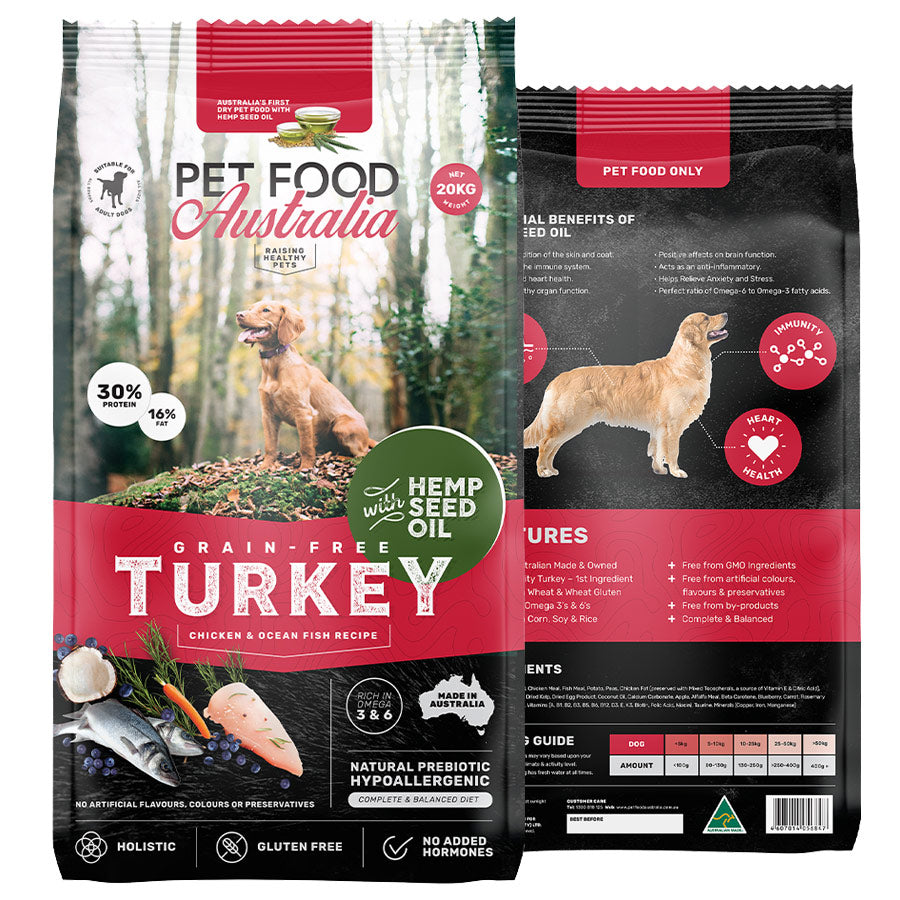
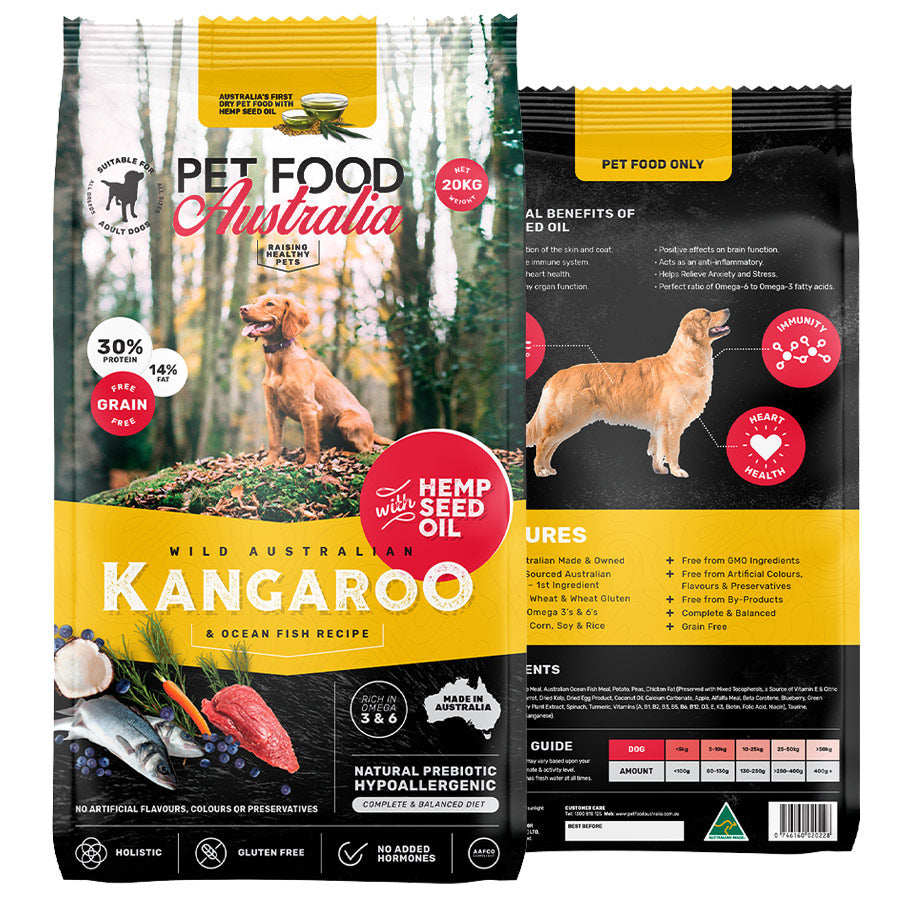
Some dogs may suit kangaroo and ocean fish.
Others may suit turkey, chicken and fish.
Some may need a lower-fat option.
The point is not one magic protein source.
The point is giving owners access to complete diets with strong protein foundations and different functional profiles.
Why We Believe the Real-World Proof Matters
We can talk about amino acids.
We can talk about crude protein.
We can talk about digestibility.
All of that matters.
But the reason we believe so strongly in this approach is that we keep hearing the same outcomes from customers:
“My dog has more energy.”
“The coat is better.”
“The scratching stopped.”
“The stools are better.”
“My senior dog is acting younger.”
“They just seem healthier.”
That is not proof of one nutrient acting alone.
It is proof that, for many dogs, the complete formulation appears to suit them extremely well.
And that is exactly what good nutrition should do.
So How Much Protein Does a Dog Actually Need?
The answer is:
Enough high-quality protein to support the dog's age, activity, muscle, body condition and overall health within a complete and balanced diet.
There is no single magic percentage.
But we believe healthy dogs generally deserve more than a minimalist approach.
Protein should be treated as a central nutrient.
Not something to fear.
Not something to maximise blindly.
But something to get right.
The Bottom Line
When choosing dog food, do not ask only:
“What is the protein percentage?”
Ask:
Where does the protein come from?
Does the food provide enough total nutrition?
Is the fat level appropriate?
Does the energy density suit my dog?
Is the recipe complete and balanced?
And most importantly: how is my dog actually doing on it?
For us, the real proof is in the dogs themselves.
When owners consistently tell us their dogs are more energetic, better conditioned, less itchy, producing better stools and acting more like themselves again, that tells us the nutritional approach is working for a great many dogs.
And that is why protein remains at the centre of how we think about dog nutrition.