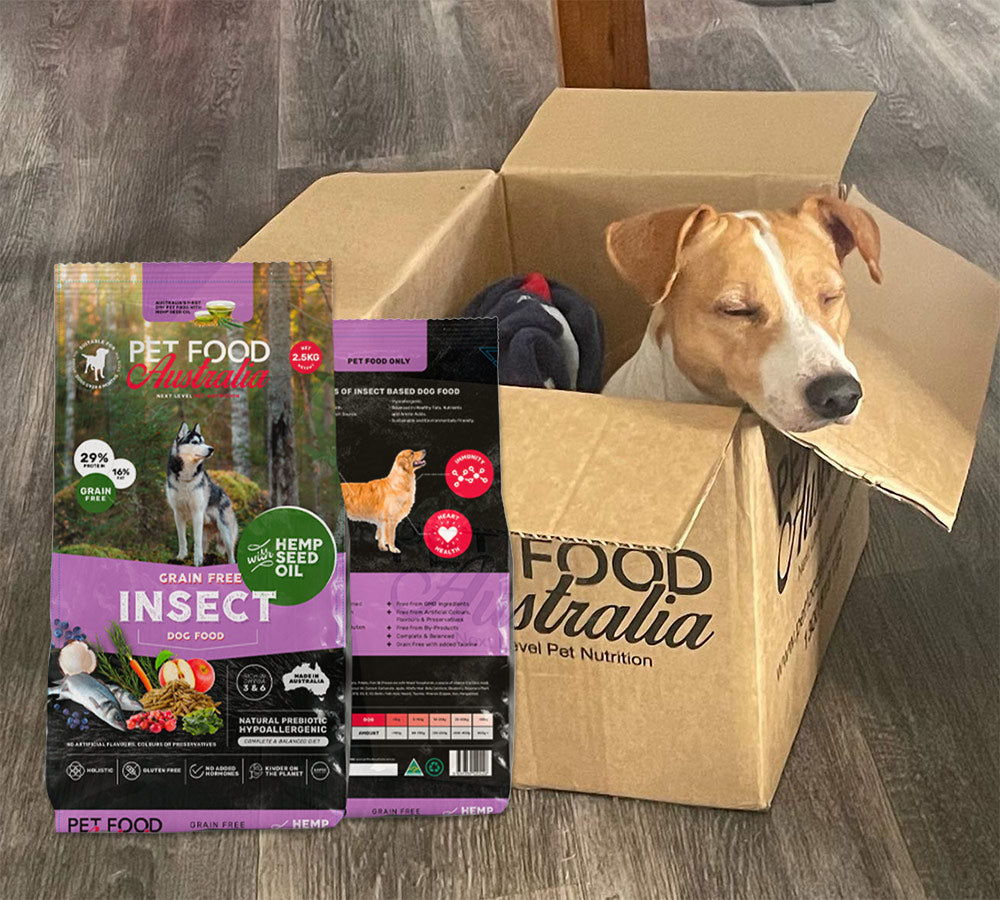

Novel Protein Dog Food: What It Is and When It May Help


“Novel protein” is one of those pet-food terms that sounds more complicated than it really is.
A novel protein is simply:
a protein your dog has not eaten before, or has had very little previous exposure to.
For one dog, that might be kangaroo.
For another, it might be duck.
For another, venison.
And for a dog that has already eaten kangaroo for years, kangaroo is no longer novel.
That point matters because novel-protein diets are often discussed as though certain meats are automatically “hypoallergenic.”
They are not.
What makes a protein novel depends on the individual dog.
Why Would Someone Use a Novel Protein?
The main reason is usually that a dog has recurring signs that make food intolerance or food allergy worth investigating.
That might include:
- persistent itching
- paw licking
- recurring ear problems
- loose stools
- gas
- vomiting
- digestive discomfort
- inconsistent stools
- poor coat condition
But these signs do not automatically mean a food allergy is present.
They can also be caused by:
- environmental allergies
- parasites
- infections
- stress
- overfeeding
- sudden dietary changes
- digestive disease
- other medical conditions
That is why a novel protein should not be treated as a magic solution.
It is one tool that may help simplify the diet and reduce exposure to familiar proteins.
Novel Protein vs Hypoallergenic
These terms are often confused.
A novel protein food contains a protein source that is new to the individual dog.
A hypoallergenic veterinary diet may use a hydrolysed protein, where the protein has been broken into very small fragments to reduce recognition by the immune system.
These are not the same thing.
A conventional kangaroo food, for example, can be useful for some dogs.
But it is not automatically equivalent to a veterinary hydrolysed diet.
Novel Does Not Mean Exotic
This is another common misconception.
A protein does not need to sound unusual to be novel.
If a dog has spent its entire life eating chicken, beef and lamb, then another protein may be novel simply because that dog has not encountered it before.
The key question is not:
“Is this an unusual meat?”
It is:
“Has my dog eaten this before?”
Why Dietary History Matters
If you are genuinely trying to investigate a suspected food reaction, knowing what the dog has previously eaten is extremely useful.
That includes:
- previous dry foods
- wet foods
- treats
- table scraps
- dental chews
- flavoured supplements
- training treats
Owners sometimes think their dog has “never eaten beef,” then discover beef was present in treats or mixed-protein foods.
That can make a supposed novel-protein trial much harder to interpret.
What Makes Kangaroo Interesting?
Kangaroo is particularly relevant in Australia because it gives owners access to a protein that may be less commonly used in some dogs’ previous diets.
It can therefore be useful for dogs that have eaten more conventional proteins such as:
- chicken
- beef
- lamb
But again, kangaroo is only novel if it is actually new to that dog.
This is why we prefer accurate language.
We do not say:
“Kangaroo is hypoallergenic for every dog.”
We say:
“Kangaroo can be a useful alternative protein for some dogs, depending on their dietary history.”
Why Owners Often Look for Novel Proteins After Skin Problems
One of the most common reasons owners search for novel-protein food is persistent scratching.
They may have already tried several diets.
They may suspect:
- chicken
- beef
- grains
- dairy
- another ingredient
Sometimes switching to a different protein helps.
But when a dog improves after changing food, it does not automatically prove the old protein was the problem.
The new food may also differ in:
- fat level
- fibre
- fatty acid profile
- carbohydrate source
- digestibility
- calorie density
- ingredient combinations
So improvement tells us something useful, but not always the exact cause.
What Pet Food Australia Customers Tell Us
This is where our own real-world experience becomes relevant.
Over the years, many Pet Food Australia customers have come to us because their dog had been dealing with:
- itching
- scratching
- paw chewing
- digestive sensitivity
- loose stools
- poor coat condition
A large number of those owners later told us their dog improved after changing foods.
In some cases, the change was dramatic.
They might say:
“The scratching finally settled.”
“His stools are normal now.”
“She stopped chewing her paws.”
“Her coat looks completely different.”
Those experiences matter to us.
But we do not pretend they prove a specific allergy.
In most cases, the exact cause was never formally diagnosed.
What they show is that some dogs appear to do much better when they move to a formulation that suits them better, and a different protein source may be part of that improvement.
Why We Offer Different Protein Options
We do not believe every dog should be forced into one universal protein.
That is why Pet Food Australia offers different recipes built around different protein combinations.
Our range includes options such as:
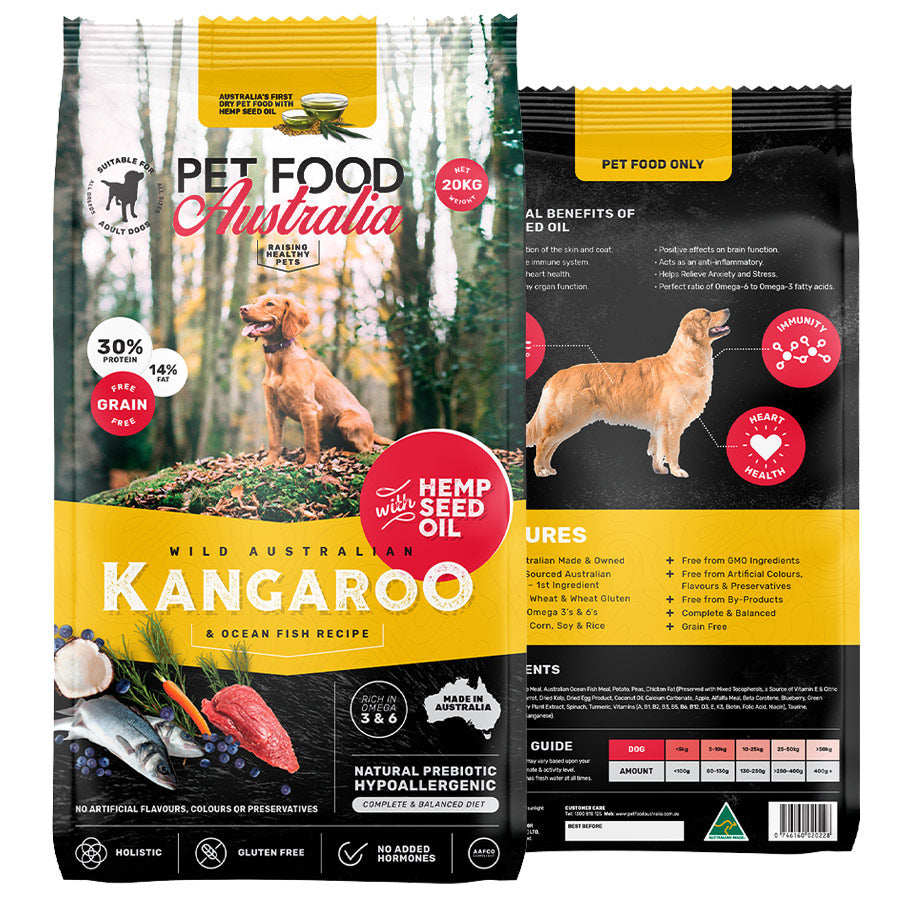
- kangaroo and ocean fish
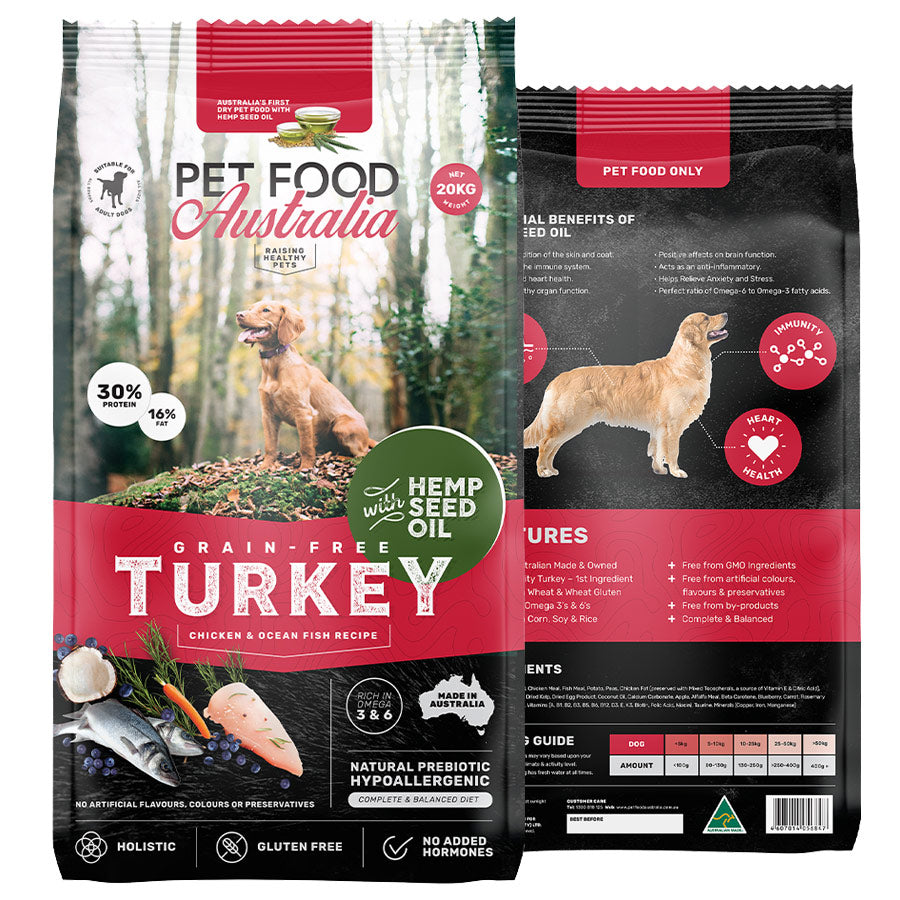
- turkey, chicken and ocean fish
- turkey and lamb
- other specialised formulations
That gives owners flexibility.
Some dogs thrive on chicken.
Some do better on kangaroo.
Some need a lower-fat option.
Some simply seem more comfortable on one formulation than another.
The point is not that one protein is universally superior.
The point is giving owners options.
Is Chicken Automatically a Problem?
No.
Chicken is often blamed because it is widely used in dog food.
But many dogs eat chicken perfectly well throughout life.
A dog scratching while eating chicken does not prove that chicken is the cause.
The same applies to:
- beef
- lamb
- grains
- peas
- potatoes
- fish
Symptoms alone cannot identify the trigger.
That is why food allergy diagnosis requires a more structured approach.
How a True Elimination Diet Works
If a veterinarian suspects food allergy, they may recommend an elimination diet.
This usually involves feeding:
- a truly novel protein and carbohydrate source
or
- a hydrolysed veterinary diet
for a controlled period.
During that time, the dog generally should not receive other food sources that could interfere with the trial.
If symptoms improve, previous foods may later be reintroduced to see whether symptoms return.
That challenge step is important.
Without it, improvement alone does not prove what caused the problem.
Why Randomly Switching Proteins Is Different
There is a big difference between:
a structured elimination trial
and
changing from chicken to lamb to salmon to kangaroo every few weeks.
Repeated switching can actually create confusion.
Every food changes multiple variables at once.
If the dog improves, you may not know what helped.
If the dog worsens, you may not know what caused it.
A more controlled approach gives you much better information.
Can Novel Protein Help With Food Intolerance Too?
Potentially.
Food intolerance is different from food allergy because it does not involve the immune system.
But a dog may still tolerate one formulation better than another.
That means a novel-protein recipe can sometimes be useful simply because it removes some of the ingredients the dog was previously eating.
Again, that does not prove the new protein itself was the only reason for improvement.
The whole formulation matters.
Why the Whole Recipe Still Matters
A novel protein does not rescue a poor formulation.
A good food still needs:
- adequate protein
- appropriate fat
- useful fibre
- complete vitamins and minerals
- appropriate energy
- good overall balance
This is especially important because owners can become so focused on finding a “rare” meat that they forget to assess the rest of the food.
Novel protein is one feature.
It should not be the entire decision.
What Should You Look for in a Novel-Protein Food?
Start with:
- Is the protein actually new to your dog?
- Is the food complete and balanced?
- What is the crude protein level?
- What is the fat level?
- What other protein sources are present?
- Does the recipe contain multiple animal proteins?
- Does the energy density suit your dog?
- Is the dog maintaining good body condition?
- Are stools consistent?
- Is scratching improving?
- Is the coat healthy?
That tells you far more than simply seeing the word “novel.”
The Bottom Line
A novel protein is not a magic ingredient.
It is simply a protein your dog has not eaten before.
That can make it useful in certain situations, especially when owners are trying to simplify the diet or investigate a suspected adverse food reaction.
But the real value comes from combining that protein with a complete and balanced formulation that suits the individual dog.
And when owners tell us their dogs are scratching less, producing better stools, looking healthier and feeling more comfortable after changing to a different protein profile, that real-world feedback tells us the overall approach is working for many dogs.

When owners start looking for a novel-protein dog food, the next question is usually:
“Which protein should I choose?”
For Pet Food Australia, two particularly relevant options are:
kangaroo
and
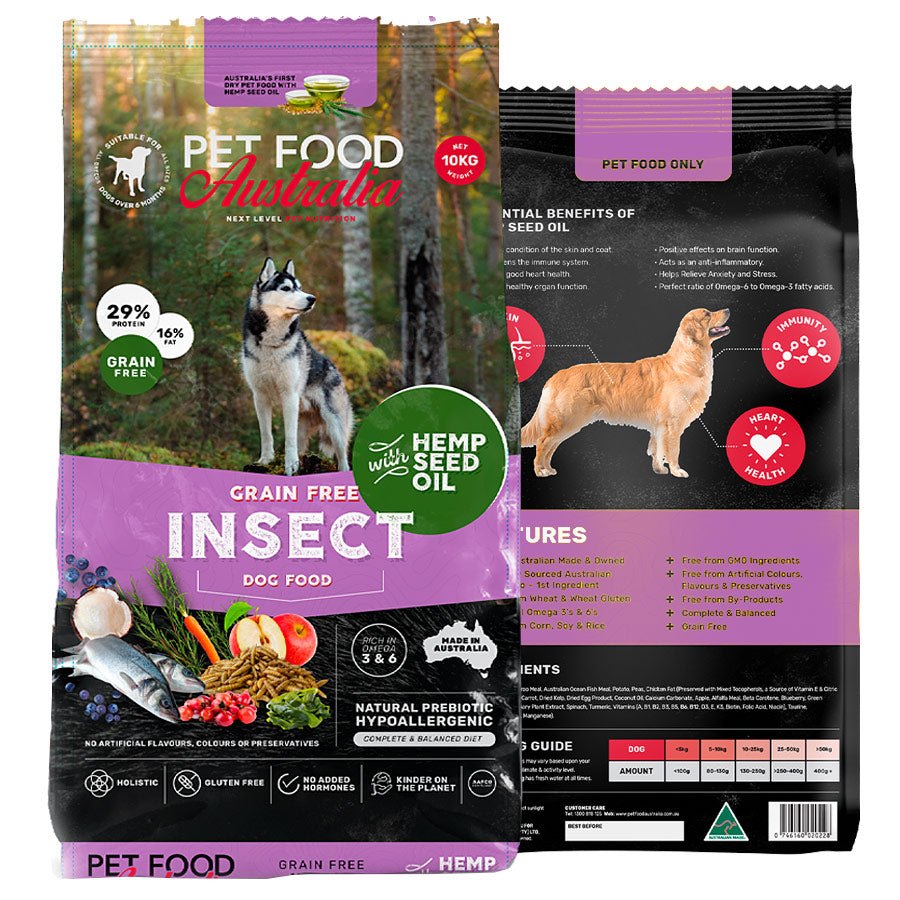
insect protein
Both can be useful because, for many dogs, they are less commonly eaten than conventional proteins such as chicken, beef or lamb.
That gives them real value when owners are trying to move away from familiar protein sources.
Why Kangaroo Can Be a Very Good Choice
Kangaroo is one of the strongest novel-protein options available to Australian dog owners.
For many dogs, it is far less familiar than:
- chicken
- beef
- lamb
- pork
That means it may be genuinely novel depending on the dog’s previous diet.
Kangaroo is also a lean animal protein source, which can make it especially attractive in a complete formulation where owners want:
- strong protein
- an alternative to common meats
- a leaner overall protein profile
- something different for a dog that has not responded well to more familiar proteins
This is why kangaroo plays such an important role in the Pet Food Australia range.
Our Kangaroo & Ocean Fish recipe gives owners a very practical alternative-protein option without forcing them into an obscure or difficult-to-source food.
But Kangaroo Is Only Novel if Your Dog Has Not Eaten It Before
This point is essential.
If your dog has already eaten:
- kangaroo kibble
- kangaroo treats
- kangaroo jerky
- mixed-meat foods containing kangaroo
then kangaroo may no longer be truly novel.
So before choosing it for a structured dietary trial, look back at your dog’s feeding history.
If kangaroo has barely or never been eaten, it can be a very sensible option.
If your dog has been eating kangaroo regularly for years, then it may still be a good food, but it is no longer “novel” in the strict sense.
Why Insect Protein Is So Interesting
Insect protein is even more unusual in many dogs’ feeding history.
Most dogs have had years of exposure to conventional proteins.
Far fewer have eaten insect-based dog food.
That makes insect protein potentially valuable for owners specifically looking for a protein their dog is unlikely to have encountered before.
Pet Food Australia’s insect formula therefore sits in a very different place from standard chicken, beef or lamb diets.
It gives owners another alternative when they want:
- a less familiar protein source
- a different nutritional profile
- another option after several conventional proteins have already been tried
Again, that does not mean insect protein will suit every dog.
But it gives owners a genuinely different choice.
Kangaroo vs Insect: Which Is More Novel?
For many Australian dogs:
insect protein may be the more novel of the two.
That is simply because kangaroo is now used more widely in Australian pet food and treats.
But novel does not automatically mean better.
The more important question is:
Which complete formulation suits your dog better?
A dog may thrive beautifully on kangaroo.
Another may do better on insect protein.
Another may do perfectly well on a more conventional protein.
Novelty is only one factor.
Why Mixed-Protein Foods Can Complicate Things
If you are trying to perform a strict elimination-style trial, mixed-protein foods can make the result harder to interpret.
For example, a food marketed around kangaroo may also contain:
- fish
- chicken fat
- another animal protein
- flavouring ingredients derived from other animals
That may still be an excellent complete food.
But if your goal is to identify whether your dog reacts to one particular protein, the more variables you introduce, the harder it becomes to know what is happening.
This is why a proper veterinary elimination trial is generally much stricter than simply buying a food with a different protein on the front of the bag.
Why Pet Food Australia Still Uses Complete Formulations
For everyday feeding, our priority is different.
We are not trying to make every commercial recipe function as a diagnostic veterinary elimination diet.
We are trying to create complete, balanced foods that give owners useful protein choices.
That means our kangaroo and insect recipes should be judged as complete foods, not simply as isolated protein experiments.
The question becomes:
Does this formulation suit my dog?
That is where real-world results matter.
What Owners Tell Us About Kangaroo
Kangaroo is one of the proteins that has attracted a lot of interest from owners whose dogs had already been struggling with:
- scratching
- itchy skin
- paw licking
- recurring digestive upset
- loose stools
- poor coat condition
We have had many Pet Food Australia customers tell us that after switching to our kangaroo-based formulation, their dogs improved noticeably.
Some report:
less scratching
better stools
better coat condition
less paw chewing
better overall comfort
Again, we do not claim that kangaroo itself “cured” the dog.
The new diet changes many things at once.
But these repeated customer reports are important because they show that, for many dogs, the overall kangaroo-based formulation appears to suit them extremely well.
Why the Whole Recipe Still Matters
A dog does not eat kangaroo in isolation.
They eat the entire recipe.
That means the result may also reflect:
- protein balance
- fish inclusion
- fat profile
- essential fatty acids
- fibre
- energy density
- feeding amount
- digestibility
- vitamin and mineral balance
That is why it would be oversimplifying to say:
“Kangaroo fixed the problem.”
A better statement is:
“Many dogs appear to do very well after moving to a complete kangaroo-based formulation that suits them better.”
Insect Protein Can Offer a Different Path
The insect formula gives owners another option entirely.
This can be useful where a dog has already eaten many common animal proteins over the years.
For some owners, it is appealing because it introduces a protein source that is genuinely unfamiliar to the dog.
And again, the same rule applies:
watch the dog.
Do stools improve?
Does scratching reduce?
Does the coat look healthier?
Is appetite steady?
Is energy good?
Is body condition appropriate?
That real-world outcome matters more than the novelty of the ingredient alone.
How Long Should You Trial a New Protein?
For digestive changes, some owners notice differences relatively quickly.
You may see changes in:
- stool quality
- gas
- appetite
- digestive comfort
within days to a couple of weeks.
Skin-related changes generally need more patience.
It can take several weeks to judge whether:
- scratching is reducing
- paw licking is improving
- coat quality is changing
- skin looks healthier
So changing food every few days is rarely helpful.
Give the dog enough time for a pattern to emerge.
Do Not Change Too Many Things at Once
If you are evaluating a novel-protein food, try not to simultaneously introduce:
- several new treats
- multiple supplements
- new chews
- table scraps
- another food
Otherwise, if your dog improves or worsens, you may have no idea why.
Keeping the diet relatively simple gives you much clearer information.
Treats Can Ruin the Experiment
This is one of the biggest practical issues.
You may carefully choose a kangaroo or insect formula, then unknowingly give:
- chicken treats
- beef dental chews
- mixed-meat training treats
- table scraps
If you are genuinely trying to test whether reducing exposure to familiar proteins helps, those extras can muddy the picture.
For strict investigation, every food source matters.
How Do You Know Whether the New Protein Is Helping?
Look for changes across the whole dog.
Digestive signs:
- firmer stools
- fewer loose stools
- less gas
- less digestive discomfort
Skin and coat signs:
- less scratching
- less paw chewing
- healthier coat
- fewer recurring flare-ups
General signs:
- good appetite
- stable body condition
- good energy
- overall comfort
One good day does not prove anything.
Look for a consistent trend.
When Improvement Is Not Proof of Allergy
This is worth repeating because it is so important.
If your dog improves after switching from chicken to kangaroo, that does not automatically prove a chicken allergy.
The new food may also differ in:
- fat
- fibre
- carbohydrate
- energy density
- fish content
- oils
- digestibility
- total ingredient balance
The dog may simply tolerate the new formulation better.
That is still useful.
It just means we should not jump to a diagnosis that the evidence does not support.
When a Formal Elimination Trial Makes More Sense
If your goal is simply to find a food your dog does well on, a complete novel-protein food may be enough.
If your goal is to diagnose a true food allergy, then a veterinary-supervised elimination trial is more appropriate.
That process is much more controlled and is designed to answer a specific diagnostic question.
For everyday owners, those are two different goals:
Goal 1: Find a food my dog thrives on.
Goal 2: Prove which ingredient caused an allergic reaction.
They should not be confused.
Why We Like Having Both Kangaroo and Insect Options
This is one of the strengths of the Pet Food Australia range.
Kangaroo gives owners a practical Australian alternative protein.
Insect protein gives them something genuinely different again.
That means owners are not limited to repeatedly rotating among:
- chicken
- beef
- lamb
if those formulas have not been working well for their dog.
It gives us more flexibility to match the dog rather than forcing every dog into the same nutritional pattern.
Which Dogs Might Be Worth Trying on Kangaroo?
Kangaroo may be worth considering when:
- your dog has mainly eaten common proteins
- you want an alternative animal protein
- your dog appears to do poorly on their current formulation
- you want a lean protein option
- you want a complete grain-free recipe built around a less familiar protein
Again, the dietary history matters.
Which Dogs Might Be Worth Trying on Insect Protein?
Insect protein may be worth considering when:
- your dog has eaten many conventional animal proteins
- you want a more unusual protein source
- you are looking for a genuinely different nutritional option
- you want to reduce reliance on familiar proteins
It can be particularly interesting when kangaroo is no longer novel because the dog has already eaten it regularly.
The Real Test Is Still the Dog
No protein earns a medal just because it is unusual.
The dog tells you whether the diet is working.
If a dog on kangaroo:
- scratches less
- has better stools
- maintains good muscle
- has good energy
- has a healthier coat
- looks comfortable
then that matters.
If a dog does not do well, the fact that kangaroo is “novel” does not make it the right food.
The same applies to insect protein.
The Bottom Line
Kangaroo and insect protein are two of the most useful novel-protein options within the Pet Food Australia range.
Kangaroo is a strong alternative animal protein and, for many dogs, may still be relatively novel.
Insect protein can be even more novel for dogs that have already eaten a wide range of traditional meats.
But neither should be judged on novelty alone.
The real goal is to find a complete and balanced formulation that the individual dog tolerates well and thrives on.

Novel proteins are useful.
But they are not magic.
And they are not always the answer.
The biggest mistake owners can make is assuming that if their dog is itchy, has loose stools, licks their paws, or has recurring ear issues, they simply need to keep searching for a more unusual meat.
Sometimes a different protein genuinely helps.
Sometimes the real issue is the overall formulation.
And sometimes food is not the main problem at all.
How Do You Choose Between Kangaroo, Insect and More Familiar Proteins?
Start with your dog’s history.
Ask:
- What proteins has my dog eaten regularly?
- Which foods have they done well on?
- Which foods seemed to coincide with problems?
- Are treats and chews adding hidden proteins?
- Is the issue mainly skin, digestion, or both?
- Has the dog ever had a proper elimination diet?
If your dog has spent years eating chicken, beef and lamb, then a move to kangaroo may make sense.
If your dog has already eaten kangaroo regularly, insect protein may offer a genuinely newer option.
If your dog has always done well on chicken, there may be no reason to avoid it purely because it is common.
Novel should mean useful, not simply unusual.
Kangaroo Is One of the Strongest Practical Options
For many Australian dogs, kangaroo sits in a very useful middle ground.
It is:
- an animal protein
- naturally lean
- less common than chicken or beef in many dogs’ feeding histories
- widely accepted by many dogs
- available in a complete dry-food formulation
That makes it a very practical option for owners who want to move away from more familiar proteins without jumping immediately to something extremely unusual.
And importantly for Pet Food Australia, we have seen a very strong pattern of positive owner feedback around our Kangaroo & Ocean Fish recipe.
Owners frequently tell us their dogs:
- scratch less
- lick their paws less
- produce firmer stools
- have healthier-looking coats
- seem more comfortable
- appear to have better energy
We cannot say kangaroo alone caused those changes.
But the consistency of that real-world feedback matters.
Insect Protein Gives You an Even More Novel Option
Insect protein can be especially useful when a dog has already eaten many conventional animal proteins.
For many dogs, it is a genuinely unfamiliar protein source.
That can make it particularly interesting when owners want to simplify previous protein exposure.
The advantage is not that insect protein is somehow automatically superior to animal meat.
Its value is that it gives owners another genuinely different option.
For the right dog, that can be very useful.
What Customer Results Can Tell Us
Customer feedback is one of the most valuable real-world signals we have.
If thousands of unrelated owners repeatedly tell us:
“The scratching stopped.”
“The stools improved.”
“The coat changed.”
“My dog finally seems comfortable.”
that tells us something meaningful.
It tells us the formulation appears to work very well for many dogs.
What it does not tell us is the exact mechanism.
We usually do not know whether the improvement came from:
- the novel protein
- the fatty-acid profile
- the fibre
- the fat level
- the carbohydrate source
- the total protein level
- the digestibility
- the removal of something from the old diet
- or the interaction of several factors together
That distinction is important.
Real-Life Proof Does Not Have to Mean Clinical Proof
There is a tendency in pet nutrition to think only in two extremes:
Either something has a formal clinical trial behind it,
or
it does not matter.
We do not think real life works that way.
Customer outcomes matter.
Patterns matter.
Repeat experiences matter.
If large numbers of owners independently report the same kinds of improvements after moving onto a particular food, that is useful evidence of real-world suitability.
It is not the same as proving treatment of a disease.
But it should not be dismissed either.
The Whole Formulation Is Often the Real Answer
This is one of the most important lessons we have learned.
Owners often ask:
“Was it the kangaroo?”
Maybe.
But sometimes that is too simple.
When a dog changes from one food to another, they may also change:
- protein level
- protein source
- fat level
- essential fatty acids
- fibre
- starch source
- calorie density
- vitamin and mineral balance
- feeding amount
So when a dog improves, the most honest answer is often:
the new formulation suited the dog better.
That is why Pet Food Australia does not treat novel protein as an isolated marketing feature.
It is part of a complete nutritional design.
Why Every Ingredient Still Has a Purpose
A novel protein only works as well as the rest of the recipe around it.
A good grain-free novel-protein food should still provide:
- strong protein
- appropriate fat
- useful energy
- suitable fibre
- essential fatty acids
- vitamins
- minerals
- complete nutritional balance
Ingredients such as potato and peas also need to be considered in context.
When used appropriately, they can contribute:
- energy
- structure
- fibre
- texture
- useful nutrients
The question should never be:
“Does it contain potato?”
or
“Does it contain peas?”
The better question is:
“What role are these ingredients playing in the overall formulation?”
Energy Matters More Than Many Owners Realise
A dog can have a technically excellent protein source and still not do well if the total energy intake is wrong.
Too many calories can contribute to excess weight.
Too few can make it difficult to maintain body condition.
The right energy density helps support:
- daily activity
- muscle maintenance
- recovery
- healthy body condition
- general vitality
This is another reason real-world feedback about energy is important.
When owners say:
“My dog seems more energetic after switching,”
that may reflect a much better overall nutritional match.
Not simply more calories.
The right calories.
Better Energy Can Be a Sign of Better Overall Suitability
This is a point worth emphasising.
A dog does not need to be hyperactive to be healthy.
But a dog that:
- gets up more willingly
- wants to play
- walks with more enthusiasm
- recovers better
- seems more engaged
may simply be feeling better.
We hear this frequently from Pet Food Australia customers.
And just like the skin and digestive feedback, it reinforces the idea that the whole formulation is affecting the whole dog.
When Novel Protein Is Worth Trying
A novel-protein food may be worth considering when:
- your dog has eaten the same common proteins for years
- you want a genuinely different protein source
- your dog appears to do poorly on their current diet
- scratching and digestive issues persist
- you want to simplify the protein profile
- you want to explore a kangaroo- or insect-based formulation
That does not mean every one of these dogs has a food allergy.
It simply means a different formulation may be worth trying.
When Novel Protein May Not Be the Answer
If your dog is itchy because of:
- fleas
- environmental allergy
- infection
- mites
- another skin condition
changing the protein alone may not solve the problem.
Likewise, if loose stools are being caused by:
- parasites
- infection
- overfeeding
- scavenging
- stress
- gastrointestinal disease
novel protein may not fix the underlying issue.
This is why context matters.
If the Dog Improves, Keep the Diet Stable
One of the most common mistakes is continuing to experiment after finding something that works.
If your dog is:
- comfortable
- scratching less
- producing good stools
- maintaining body condition
- eating well
- energetic
- looking healthy
there is often no need to keep rotating proteins just for the sake of variety.
Consistency can be valuable.
Once you find a complete food that suits the dog, give that success time to continue.
Do You Need to Rotate Proteins to Prevent Allergy?
There is no good reason to assume that constantly rotating proteins will prevent food allergy.
Allergy requires prior exposure, but repeated exposure does not mean allergy is inevitable.
Most dogs can eat familiar proteins for years without developing a problem.
So we would not recommend random rotation purely out of fear.
Protein rotation should have a reason.
What About a Dog That Has Tried Everything?
This is where insect protein becomes especially interesting.
Some dogs have already been through:
- chicken
- beef
- lamb
- salmon
- kangaroo
and owners are still looking for something genuinely different.
In those cases, insect protein can offer a fresh option.
Again, not because novelty itself is therapeutic, but because it gives the dog a protein source they may never have encountered before.
Why We Believe Choice Matters
Pet Food Australia offers different protein profiles because dogs are different.
Some dogs do beautifully on common proteins.
Some seem to do better on kangaroo.
Some may suit insect.
Some need lower fat.
Some need different energy density.
The goal is not to find the “best protein in the world.”
The goal is to find the best formulation for that individual dog.
The Strongest Proof Is the Pattern Across the Whole Dog
A dog eating well is good.
A dog liking the taste is good.
But the strongest sign is when several things improve together:
- better stools
- less scratching
- better coat
- good body condition
- better energy
- good appetite
- overall comfort
That is what we pay the most attention to.
It tells us more than one isolated symptom ever could.
Why Pet Food Australia’s Experience Matters
We are not looking at this purely from a theoretical perspective.
We have decades of hands-on experience with dogs and now years of feedback from owners feeding our products.
That gives us a large body of practical observation.
We repeatedly hear from owners who came to us because they were struggling with:
- itchiness
- scratching
- paw chewing
- loose stools
- poor coat
- low energy
and later told us their dog was doing substantially better.
That is why we believe novel proteins have a real place.
But we also believe the complete formulation is what ultimately matters.
The Bottom Line
Novel protein can be an excellent tool.
For Pet Food Australia, the two most relevant options are:
Kangaroo — a strong, lean alternative animal protein that may be novel for many dogs.
Insect protein — an even more unusual option for dogs that have already eaten many conventional proteins.
Neither is automatically superior.
Neither is a guaranteed fix.
But both give owners useful choices.
And when those proteins are used inside a complete, balanced formulation that provides the right protein, fat, fibre, energy and essential nutrients, they can work extremely well for the right dog.
The final test is not how unusual the protein sounds.
It is:
Does the dog thrive on it?
That is where the real proof lives.